
Just over a month after publication, the new peer-reviewed guideline for implementing therapeutic carbohydrate reduction is reaching a growing audience—and the conversation around it continues to expand.
Published October 2 in the Journal of Metabolic Health, “A Delphi consensus-based guideline for the implementation of therapeutic carbohydrate reduction in metabolic disorders” has now recorded more than 12,700 article views, along with more than 5,900 abstract views. (Visit this link for the latest view totals: https://journalofmetabolichealth.org/index.php/jmh/article/view/152/)
But some of the most encouraging developments are happening beyond the journal page.
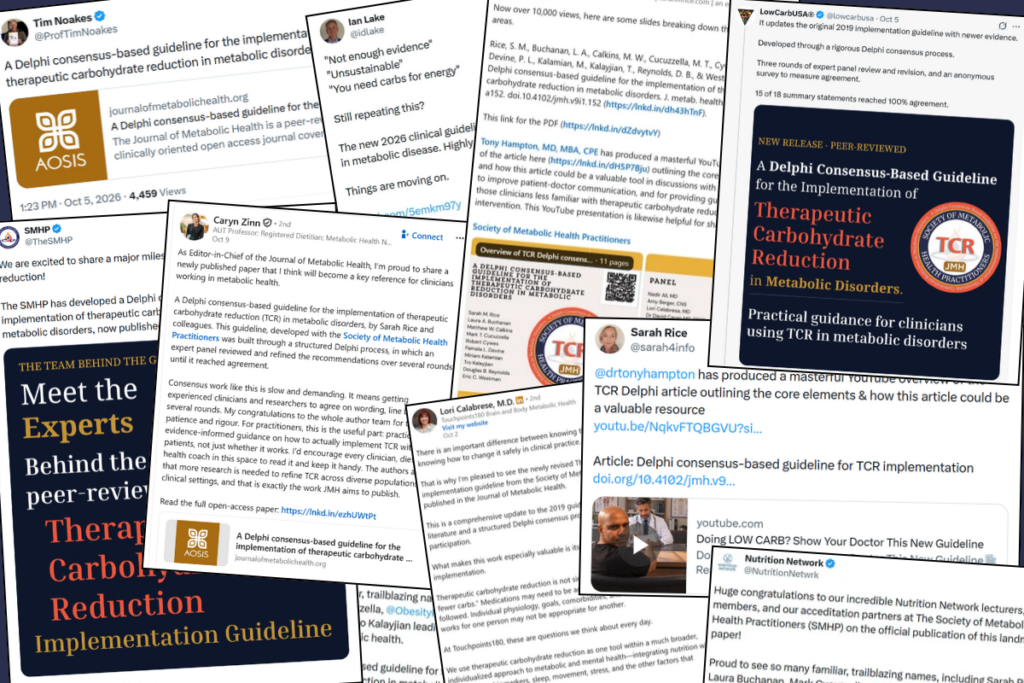
Clinicians, researchers, metabolic health organizations and members of the wider community are sharing the paper, explaining why it matters and helping introduce it to people who may not otherwise have encountered it.
Publication was never intended to be the finish line.
The important work now is getting this resource into the hands of people who can use it.
The Conversation Is Spreading
One particularly visible example has come from Tony Hampton, MD, MBA, ABOM, CPE, MSHNFM, who participated as a member of the Delphi panel.
Dr. Hampton created an in-depth video explaining the guideline and its practical significance for both patients and healthcare professionals. The video has already generated more than 20,000 views.
Video: Doing LOW CARB? Show Your Doctor This New Guideline

Dr. Hampton begins with a scenario that will be familiar to many people in the low-carbohydrate community: a patient changes what they eat, sees meaningful improvements in metabolic health, and then finds themselves trying to explain—or even defend—that approach during a medical appointment.
The guideline gives that patient something substantive to bring into the conversation.
At the same time, it gives clinicians a resource for addressing a different and equally important question:
If therapeutic carbohydrate reduction is appropriate for this patient, how do we put it into practice safely and effectively?
Dr. Hampton highlights several areas that deserve attention, including personalization, medication review, appropriate monitoring and ongoing follow-up.
And he is far from the only person helping carry this work forward.
Professor Tim Noakes, another member of the Delphi panel and one of the most influential voices in low-carbohydrate research, shared the publication with his audience.
Physician Ian Lake highlighted the guideline while addressing familiar objections to carbohydrate reduction, describing the resource as “highly readable” and “highly practical.”
Caryn Zinn, PhD, Editor-in-Chief of the Journal of Metabolic Health, described the paper as “practical, clinician-focused, and free to read,” while Nutrition Network called it a “landmark paper” and a “practical, evidence-informed roadmap.”
And Lori Calabrese, MD, MHP, who also participated on the Delphi panel, captured one of the central reasons the guideline matters:
“There is an important difference between knowing that metabolic health matters and knowing how to change it safely in clinical practice.”
That distinction sits at the heart of this work.
A peer-reviewed guideline can only have an impact if people find it, read it, discuss it and ultimately use it. We are grateful to everyone who has already helped expand its reach, and we look forward to seeing the many other ways this resource can continue reaching clinicians, patients and communities around the world.
What the Guideline Provides
For those encountering the guideline for the first time, therapeutic carbohydrate reduction, or TCR, is the deliberate reduction of dietary carbohydrates for therapeutic purposes.
The degree of carbohydrate reduction can vary considerably depending on an individual’s health, goals, preferences, metabolic response and circumstances.
The new guideline does not prescribe one rigid diet. Rather, it provides a framework for individualizing TCR while addressing many of the practical questions clinicians encounter when helping patients implement it.
The paper updates the TCR implementation document first published in 2019 and incorporates newer evidence within a formal Delphi consensus process.
A total of 26 participants—16 Delphi panel members and 10 steering committee members—were involved in the predetermined process. Twenty-six completed the final consensus survey. All 18 summary statements reached the level of consensus, and 15 achieved unanimous agreement.
The result is a comprehensive resource addressing issues that can become critically important in clinical practice, including patient assessment, contraindications and cautions, medication management, monitoring, dietary individualization, adaptation, follow-up and long-term support.
For a more detailed look at the development, methodology and history behind the guideline, see our original article:
A Major Step Forward for Therapeutic Carbohydrate Reduction
Personalization, Medication Review and Follow-Up
Several of the themes highlighted by Dr. Hampton and others help illustrate why practical implementation guidance is so important.
First is personalization.
TCR can encompass different levels of carbohydrate reduction, and the guideline emphasizes the importance of considering therapeutic goals along with individual preferences, culture, budget and nutritional requirements. Nutritional ketosis is not required for every patient or every metabolic goal.
Second is medication review and patient safety.
Changes in carbohydrate intake can produce rapid changes in blood glucose and blood pressure. For patients taking insulin, sulfonylureas, antihypertensive medications or certain other medications, those improvements may require active medical management.
Medication review, appropriate monitoring and individualized adjustment are therefore integral parts of responsible implementation.
Third is follow-up and support.
The intervention does not end when someone changes what is on the plate. The guideline addresses baseline assessment, monitoring, adaptation symptoms, ongoing care and circumstances in which additional expertise may be appropriate.
Those are precisely the practical considerations that can help turn an intervention supported by research into care that works for an individual patient.
Knowing that carbohydrate reduction may improve metabolic health is not the same as knowing how to implement it responsibly.
That is why the growing discussion around this paper is so encouraging.
This Resource Was Created to Be Used
The initial attention surrounding publication has been gratifying, but this guideline was never intended to create a one-time social media splash.
It represents an important long-term development for therapeutic carbohydrate reduction and an ongoing part of the SMHP’s mission to help translate metabolic health science into responsible clinical practice.
We will continue educating around the guideline, discussing its recommendations and helping make it accessible to healthcare professionals and the wider metabolic health community.
And we encourage you to help.
Read it. Download it. Save it. Share it with a colleague. Send it to a clinician who may be interested in therapeutic carbohydrate reduction. Discuss it with your healthcare team.
The complete peer-reviewed paper is open access.
[READ THE FULL GUIDELINE IN THE JOURNAL OF METABOLIC HEALTH]
For additional background on its development, methodology, authors, Delphi panel and the work that began with the original 2019 TCR implementation document:
READ: A MAJOR STEP FORWARD FOR THERAPEUTIC CARBOHYDRATE REDUCTION
This resource was created to be used.
Every practitioner who reads it, every colleague who receives it and every clinical conversation it helps start moves this work another step forward.